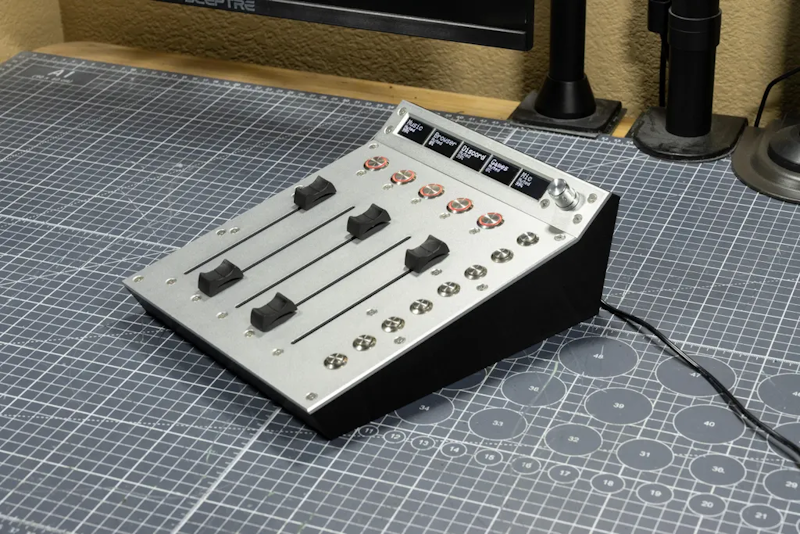
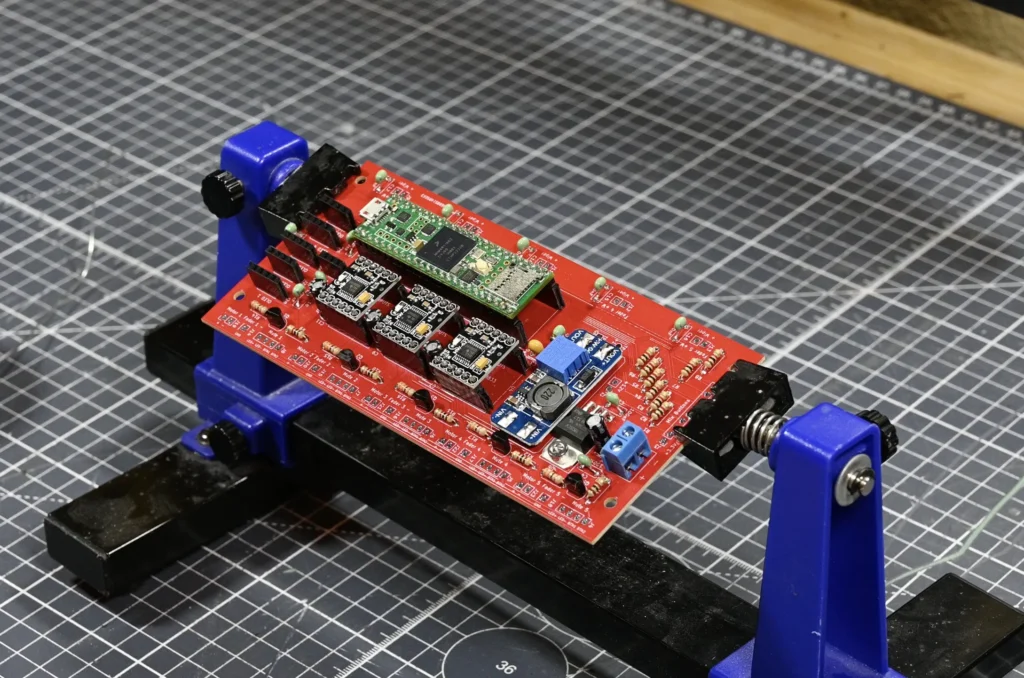
YouTuber Computer Hardware Tips and Tutorials (CHWTT) wanted a device that could control individual app volumes on their PC. Inspired by the deej project, they created a Teensy 4.1-based five-channel mixer that would look at home in any professional studio.
Mimicking expensive broadcast mixers like the GoXLR, the device features five motorized faders with OLED scribble strips above each. Additional buttons allow mixes to be stored and recalled, as well as channels to be instantly muted. Teensy’s USB MIDI functionality is combined with MIDI Mixer software to allow control over individual PC app volumes via dedicated faders, as well as represent any adjustments made via software, thanks to their motorization.
A wonderfully detailed build guide is available on Instructables, including STEP files for the custom CNC’d faceplates, STL files for the 3D-printed parts, full bill of materials, and source code. Learn more and see it in action in the video below!
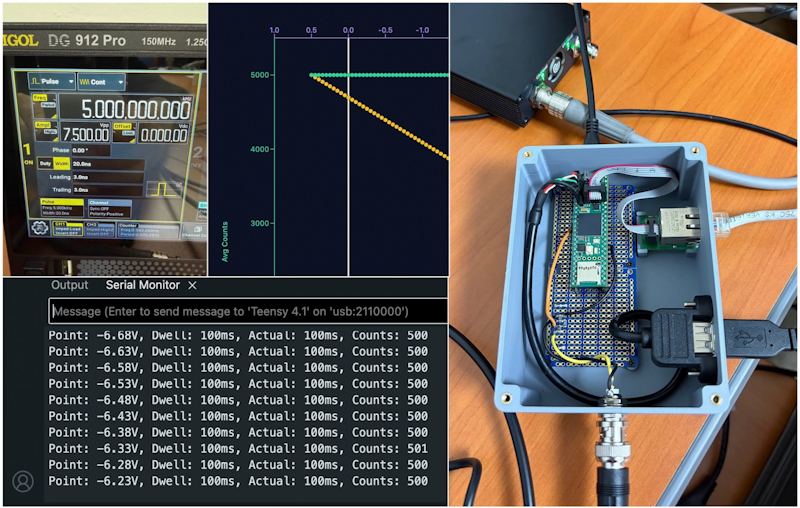
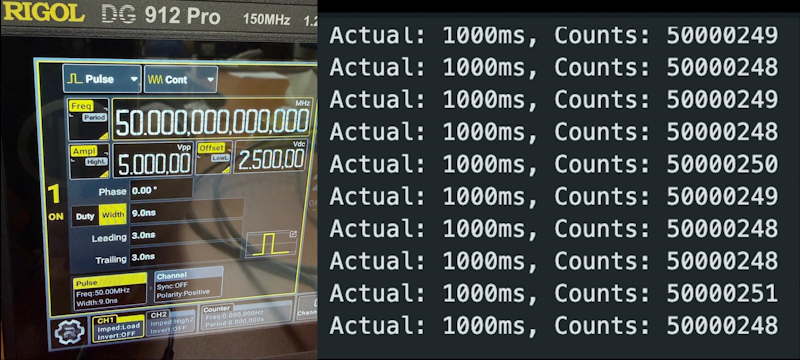
Yongsup Park has created a high-speed Teensy-based pulse counter with reliability down to a pulse width of 20ns or less — performance which typically requires equipment costing hundreds, or even thousands of dollars.
Using the FreqCount function, Yongsup iteratively reduced the pulse width until behavior became erratic. The Teensy 4.1’s 600MHz clock gives a theoretical resolution of 1.67ns, and was observed counting as little as 9ns pulse widths at 50MHz. The Rigol DG912 Pro waveform generator being used to test it has a rise/fall of 3ns, so reducing further would have been hard to measure anyway.
The pulse counter is part of a larger data acquisition app that runs in the browser without the need for a computer, using a Teensy 4.1 as a web server, USB device controller, and pulse counter. Testing results, code, and more can be found in the original forum thread.
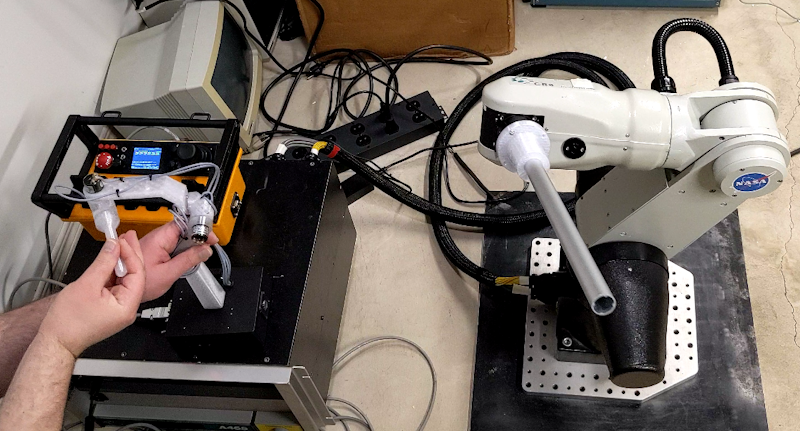
The 70lb lab-grade arm came with no software, but was still in running order. Instead of an FPGA, alnwlsn choose the powerful Teensy 4.1 to replace the embedded 486, FPGAs, and DSP chips that controlled the original. The main control loop is handled via IntervalTimer, which runs PID controllers, reads encoders, and writes to motors.
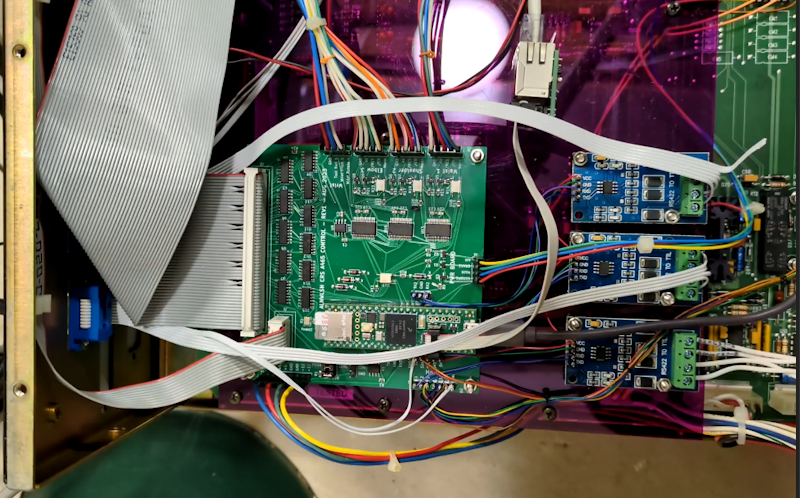
A custom PCB provides DACs for the ±10V analog signals required by the motor amps. A surplus control box refitted with a Teensy 3.2 provides manual control, and a mini reproduction of the main arm enables mimicry of its manipulation by the larger unit. 16MB of PSRAM allows several minutes of motion recording and playback, and the SD card stores encoder positions between reboots, to prevent the need for calibration each time. alnwlsn says that almost every pin on the Teensy is used for something, and you can see them in use in the video below!
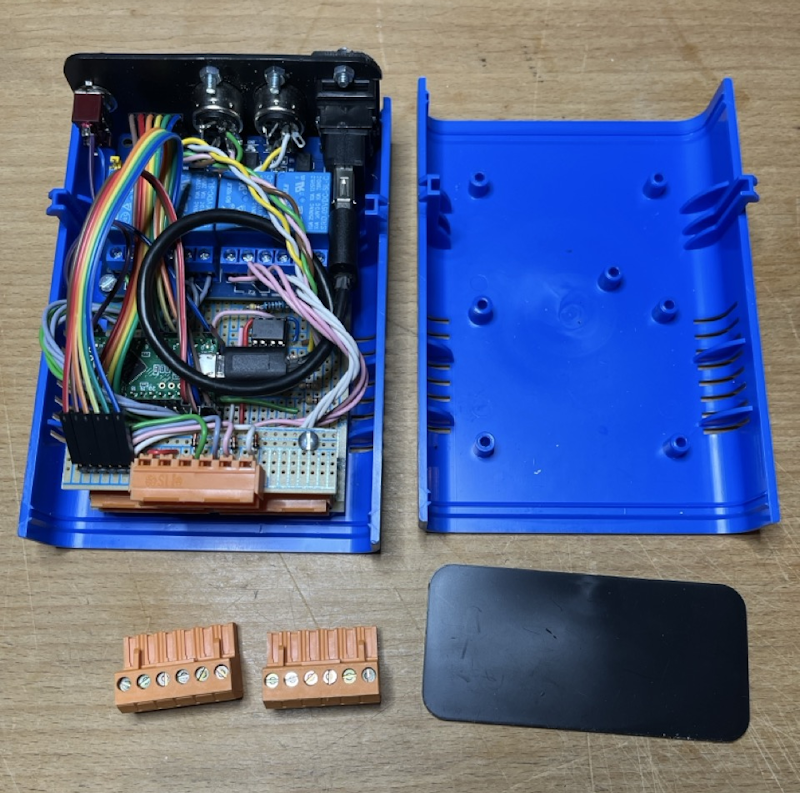
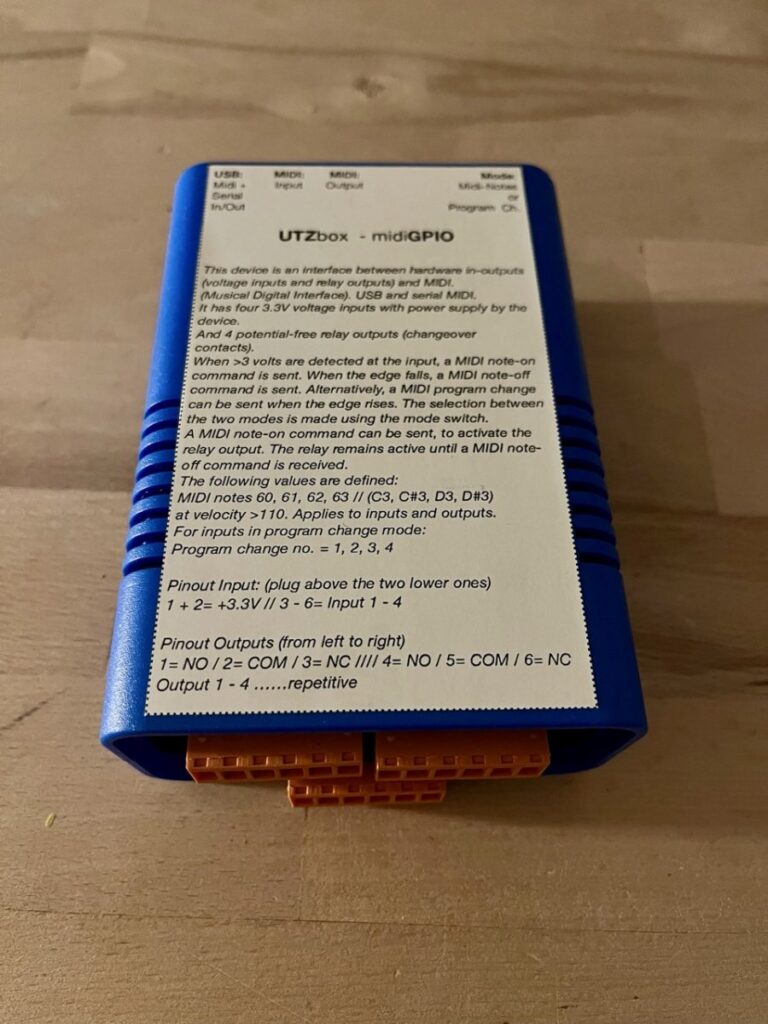
Often in music or art projects, sensors are used to trigger audio or other events via MIDI, and sometimes in the other direction too. For example, a sound effect of a door creaking that triggers when as it opens on stage, or turning on lights in response to the playing of a particular note. The self-contained unit provides four 3.3V inputs and four 3.3V outputs, and supports USB and serial MIDI. When a rising edge is detected on an input, a MIDI Note-On message is sent; similarly, a Note-Off is sent on a falling edge. The input edge detection can also be used to trigger a MIDI program change. Outputs are controlled via MIDI Note-On and -Off as well.
Check out the GitHub repo for source code, schematics, and more detail.
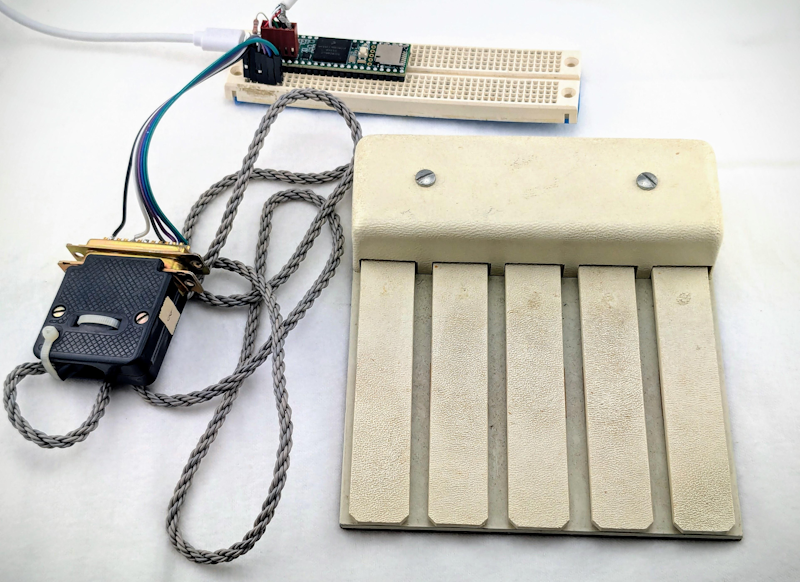
We love Ken Shirriff projects, and Ken Shirriff seems to love Teensy too, if the number of our boards we’ve seen used in his various retrocomputing restoration projects are anything to go by. Ken apparently managed to get a loan of one of the original “keyset” devices from Douglas Engelbart’s famous “Mother of All Demos,” during which the concept of a computer mouse and GUI were introduced to the public for the first time. That the keyset was also introduced to the public for the first time at the event is perhaps less worthy of mention, since it didn’t catch on in the same way as some of the other demonstrated tech which we now take for granted. While chorded keyboards are still a thing (particularly among stenographers), and we’ve even shared a Teensy 4.1-powered recreation of Engelbart’s chording keyset on the blog before, it’s certainly a niche device, and Ken even concludes his blog post by saying that he found it hard to use, both physically and mentally. But the cool thing is that he made it work, so let’s focus on that!
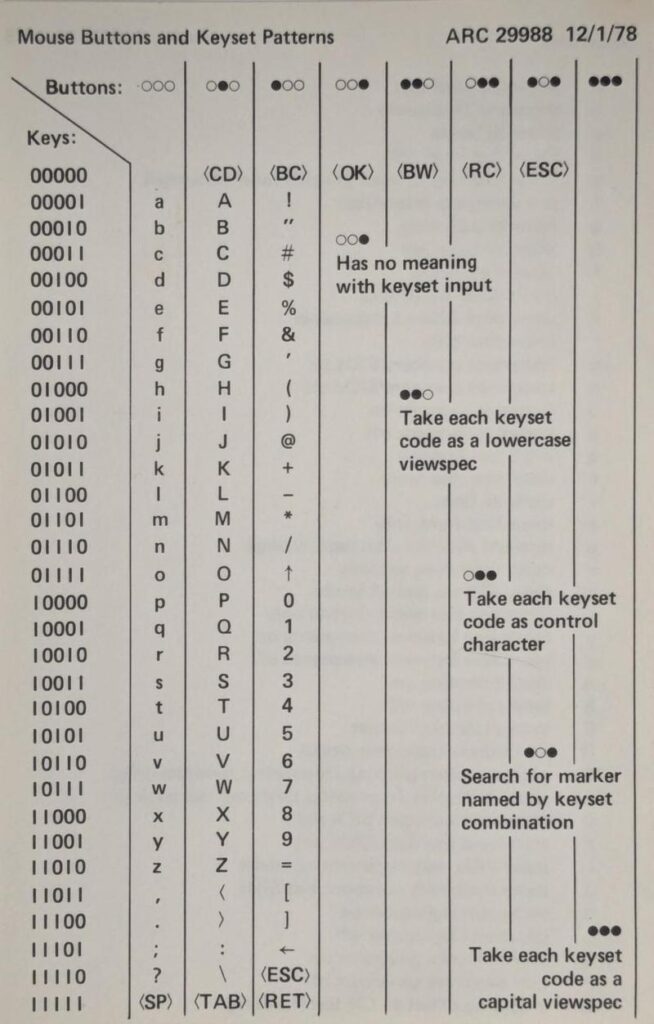
Ken’s project is based around the Teensy 3.6’s ability to act as both USB device (connecting to the host PC) and USB host (for connecting a standard USB mouse, required to get the full range of outputs, by being pressed in conjunction with the keyset keys). The Teensy is connected to the keyset’s standard DB-25 connector, with a 1kOhm pull-up resistor on one of the lines, in addition to the Teensy’s own onboard pull-ups on each. Code was added to pass through mouse input, except when used in conjunction with the keyset, as well as output the resultant characters as if it were a normal keyboard. Ken goes into glorious detail on the background of the device and its famous demo on his blog, and has shared the code on GitHub. While he may not have fallen in love with the keyset workflow, we are enamoured with the incredible journey he took to reach that conclusion.