Science World Building Model Lighting

OH! is a sculpture created by PJRC forum member brendanmatkin and the Tangible team, which controls the lights on the Telus World of Science’s geodesic dome.

Based on the Teensy 3.5, OH! is a 1:60 scale model of the building, covered with 240 sensors, and connected to its full-scale counterpart by an LTE router.

When the sensors are interacted with, the corresponding light on the “real” dome is illuminated with various animations, such as sparkles, bands, and waves. PCA9617 I2C bus repeaters connect the 240 sensors, with a WIZ820 network module providing Ethernet. The Teensy also outputs an OSC signal on the LAN for the remote laptop to turn into music via Pure Data. Each sensor features an ATtiny841 microcontroller, an LED, and an IR sensor. Marvel as the Vancouver public animates the skyline with their very own hands in the video below.

Drone Synth with Soundfonts

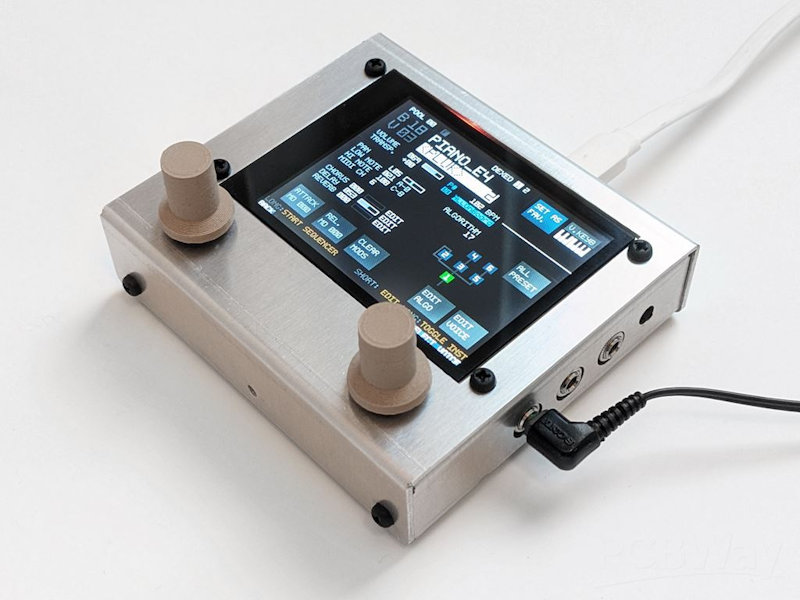
After several years of experimentation, PJRC forum user JonathanZ has released a Teensy 4.1-based drone synth pedal using S. Christian Collins’ GeneralUser GS SoundFont bank.

Built around the Teensy Audio Adaptor Board and a 2.8″ ILI9341 touchscreen, the project leverages Kris Kasprzak’s Slider Controls for Touchscreen Displays library for its UI. manicken’s Sound Font Decoder for Teensy 4.1 also facilitated the project greatly. Source code for the ISO-Drone, as Jonathan calls it, can be found on GitHub, and an overview of its features and functionality can be seen in the video below.

DIY Handheld CNC Router

When most people think of CNC machines, they think of big, loud, messy, somewhat dangerous tools that take up a large amount of space. Traditional woodworking tools are often far smaller and more maneuverable, but lack the precision of Computer Numerical Control.

Cam Chaney’s open-source Compass handheld CNC router combines the fidelity of CNC with the flexibility of a hand tool that traverses the workpiece under human guidance. Four PMW3360DM optical gaming navigation (mouse) chips feed their data into a Teensy 4.1, which uses rigid body dynamics equations to determine the precise location and orientation of the attached Dremel rotary tool, continually autocorrecting the cut. This allows the use of traditional CAD/CAM software, with the added flexibility of being able to drag the device around walls, or other surfaces that would not usually find themselves on a CNC machine bed (plus, no need to worry about jigs/workholding!). More information is available on the Compass web site.

NASA Loves Teensy

PJRC forum member dukeblue219 has shared a retrospective of NASA’s use of Teensy boards over the past six years.

Starting with the Teensy 3.1 testing planar NAND flash at the Lawrence Berkeley National Lab, its many uses have most recently included facilitating research with an 8 Tb, 96-layer 3D NAND flash via a Teensy 4.1.

Generally, devices are used for fun NASA-type evaluations such as testing for “single-event upsets” (a flipped bit), “single-event functional interrupts” (a crash) or “single-event latch-up” when radiation completely short-circuits a component. More examples and pictures can be seen in the original thread.

DIY Thermocam

Thermal imaging is another one of those technologies that seemed out of reach not so long ago, almost the realm of science fiction as in 1987’s Predator, where a Forward Looking Infrared (FLIR) camera is used for the titular extraterrestrial’s vision.

But as with so much other tech, access to infrared thermography has been democratized over time, with a great example being the Teensy 4.1-based DIY-Thermocam V3. In addition to a 3.2″ TFT LCD touchscreen and mass storage device capabilities for image transfer, the DIY-Thermocam V3 can even stream thermal images over USB serial. The software’s already extensive capabilities can be extended even further thanks to open-source, PlatformIO-based firmware. Images are saved to the internal microSD care at a resolution of up to 640×480, with 18 different color schemes. A 2000mAh battery allows 4-6 hours of operation. Find out more on the DIY-Thermocam web site.

3D Rendering

The PJRC forums are a great place to collaborate, share, and learn. It’s incredible to watch projects evolve and members learn from each other, and often even we are blown away with some of the things folks do with Teensy.

Case in point: JarkkoL’s port of their tiled software rasterizer. JarkkoL’s initial port targeted the ILI9341 LCD driver at 320x240x16 bits per pixel (bpp) via SPI, with 16bpp frame and depth buffers. Running on a Teensy 3.6, the rasterizer uses just 27kb of RAM, with 4,000 triangles stored in flash. As the thread unfolds over a little under two months, more and more enhancements are added, including asynchronous DMA transfer, cluster visibility culling, and texture support.

A port to Teensy LC was accomplished in just 8kb, and the Teensy 4.0 port pushed 16bpp updates at 49 frames per second. We hope to see these examples developed into a full library soon!

Constructive Synthesis Book

We have a lot of Teensy enthusiasts, especially in areas like audio synthesis, some with such passion and knowledge, you might say they could write a book on it. In the case of Ken Wessen, this is literally the case, in the form of the web-based book Constructive Synthesis.

In addition to comprehensive coverage of subtractive synthesis topics, the site also includes over 30 web apps that allow the reader to experience concepts first hand, as well as ten projects for the Teensy 4.0 + Audio Adaptor Board. The projects culminate in the creation of Mentor, a 16-voice polyphonic Teensy-based synth, optimized for learning subtractive synthesis and patch creation. Start learning how to make your own Teensy-based synth today, and be sure to let Ken know if you have feedback or suggestions!

ProtoTracer – 3D Rendering Engine

When games like Wolfenstein 3D debuted in the early 90s, their raycasted 3D graphics seemed like a dramatic leap forward compared to most side-scrolling games of the time.

Fast forward three decades, and most mobile phones have powerful 3D accelerators that make games from even a few years ago look unsophisticated. But PJRC forum member coelacant1 has brought back this classic software rendering technique with a custom rendering engine for the Teensy 4.0. Rather than rendering 3D objects on a monitor, coelacant1’s ProtoTracer is designed for use with LED matrices, such as those found in their own line of LED masks. Converters for 3D FBX and OBJ files, as well as 2D PNGs, BMPs, JPEGs and more allow the rendering and animation of numerous assets on arbitrary LED hardware. Source code and instructions, as well as links to the aforementioned conversion tools can all be found in the project’s GitHub repo.

Magic Dice Box

The annual YouTube Makers Secret Santa has resulted in all manner of creative and exciting projects being created as gifts between its high-profile participants, and 2024’s was no exception.

DJ Harrigan, aka Mr. Volt drew Crescent Shay, which was a fortuitous pick given that they are already friends who play Dungeons & Dragons together. This lead to the idea of a dice box, to hold and display Shay’s dice collection, but with an added Teensy 3.5-powered twist.

In addition to the “analog” dice tower to facilitate rolls, Harrigan incorporated a digital dice roller via an LCD screen and two rotary encoders. Sound effects are also played via a DAC and the Teensy’s mSD card. Lastly, the Teensy illuminates the analog dice storage area with LEDs for a little extra pizazz. See it all in action in the video below!

8×14 1U MIDI and Audio Interface

DeftAudio, aka Andrei Kudryavtsev has created an 8×14 1U MIDI and Audio Interface based on the Teensy 4.1.

With 8×8 5-pin MIDI DIN in/out, plus six MIDI TRS outs (which can also be configured as 5V Trigger out or Sync out for controlling Eurorack modular gear, drum machines, or analog synthesizers), as well as USB MIDI and a 2×2 audio interface, which seems almost absurd for a kit that starts at $25 for the main PCB. An OLED display and two rotary encoders provide the interface.

Best of all the project is completely open-source, with schematics, firmware, and even the enclosure available on GitHub. The “Complete Electronics” kit (bring your own Teensy and front panel) is just $40, while the fully assembled model will set you back $225 — still a steal for this level of functionality. Check out the video below, then head over to Tindie to pick up a kit!