BigFoot – Midi Foot Controller

PJRC forum member pgi has created an impressive Teensy LC-based MIDI foot switch controller named BigFoot.

The elegant stacked-PCB system features eight assignable footswitches, bank selection, two expression pedal connectors with TRS/RTS switch, USB MIDI in/out, and MIDI DIN out.

Plan is to later build a full enclosure that will strengthen the structure.

Source code, schematics and BOM can be found on GitHub.

Giant LEGO Minifig

The Sketchy Maker wanted to do something big for Star Wars day, but with only two weeks to put it together, this was a rather tall order.

The idea of a giant LEGO Luke Skywalker with working lightsaber came to mind, and thankfully a Teensy 3.2 and Prop Shield was at hand, greatly facilitating the electronic aspects of the project.

The minifig itself is 3d-printed, with a servo to move the lightsaber-toting arm up and down. Ninety WS2812B LEDs light said saber, and a small speaker adds sound effects. The Sketchy Maker finished the project in time for its May the Fourth debut, and put it on display for the local community to enjoy.

Ableton Collaboration Controllers

Swedish sound designer Christian wanted to jam with other musicians using Ableton Live, but it wasn’t working. Instead of playing cooperatively, it seemed like everyone would end up in their own little bubbles, locked in a volume arms race that typically results in one big sonic mess.

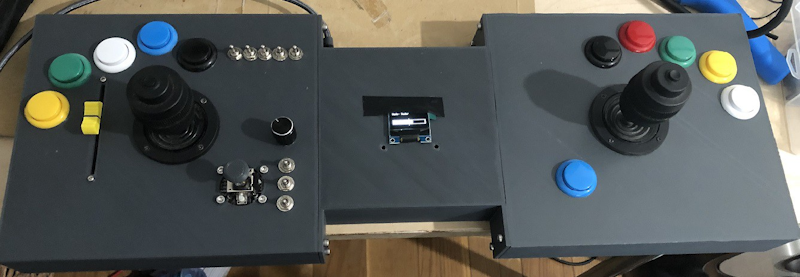
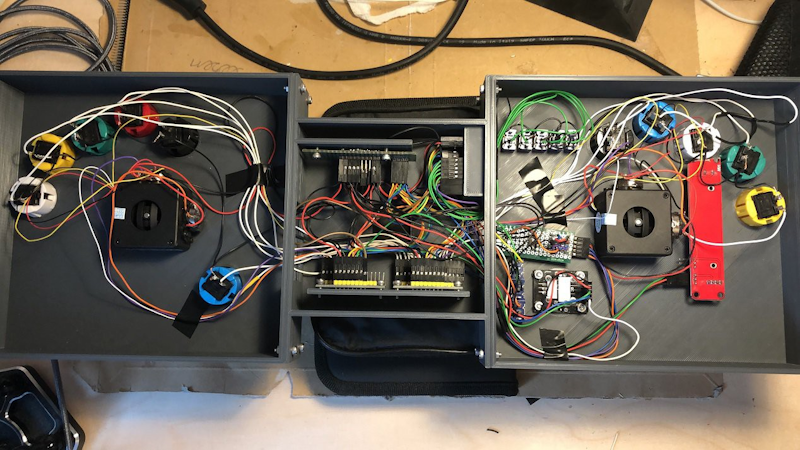
The solution? Custom controllers to gather loops from everyone, all orchestrated by a Teensy 3.5.

The resulting setup gives each musician their own channels, with someone controlling the overall mix, as well as their own sync button, headphone monitoring, and ability to contribute clips on the fly. The controllers connect to the Teensy via ethernet, which in turn talks to the host computer via a Max patch over USB serial using Open Sound Control (OSC) to talk to Ableton.

Clips start playing as soon as they are recorded, and looping status is indicated by eight RGB LEDs (red when recording, green while playing). Like a DJ cuing up the next track, the central knob acts as a crossfader, allowing the performer to experiment using headphones while only the loop is heard by the audience. Find out more about this unique system on Hackaday, or see it in action in the video below.

A Clock with Benefits

When Jim Harvey aka WB8NBS finally got his hands on an 64×64 RGB LED matrix, the question quickly became what to do with it. Experimentation with libraries and examples eventually led to the notion of a digital clock, and ultimately to Jim’s Sand Clock or “Clock with Benefits.”

Based on a Teensy 3.6, this unique timepiece adds some interesting features to the traditional timekeeping appliance.

A SmartMatrix SmartLED Shield provides the glue between the Teensy and the panel, and Phil Burgess’ PixelDust library powers an hourglass mode, plus a fun bonus illustrated in the video below. Learn more on Jim’s blog, or grab the code from Dropbox.

Atari ST Emulation with MIDI & VGA

Teensy forum member Jean-Marc, who you may recall from his Teensy 4.0 Atari 520ST Emulator, is back with some exciting updates on the project.

For starters, as fun as it is to output the display to a tiny 320×240 TFT screen, some tasks are more practical on a “real” monitor — which is now possible thanks to the addition of VGA output.

In addition to its groundbreaking GEM-based GUI, the ST excelled in audio, with Cubase and Logic Pro both originating on the platform. Two standard 5-pin DIN MIDI ports allowed the computer to talk to other instruments as well, and thanks to Teensy’s USB MIDI support, sequencers running in the emulator can also output to real MIDI devices (with the appropriate dongles).

Complete project details and updates can be found on GitHub. Note that a Teensy 4.1 with PSRAM added is required for full 640×400 display resolution.


Portable Data Acquisition System

Teensy boards power all manner of commercial products, being an ideal solution for high-speed data acquisition, and we were particularly excited by this system from Bolder Flight Systems.

BFS CEO Brian Taylor shared this Teensy 3.6-based unit, which was developed in conjunction with the International Test Pilots School (ITPS) to facilitate test pilot and flight test engineer training on fixed or rotary-wing aircraft.The system logs inertial navigation data, airspeed, altitude, temperature, and 12 additional analog channels at a rate of 200Hz, with GNSS satellite integration to aid the accuracy of inertial data. The analog channels can be used for measuring pilot stick force or control surface positions. The unit is USB-powered and easily installed, with a web-based interface for real-time data viewing and configuration. More information can be found on the BFS web site.

Aetherharp – MIDI Air Harp

We love alternative musical interfaces.  XenonJohn’s Aetherharp uses inexpensive Sharp GP2Y0A41SK0F analog distance sensors to determine hand proximity.

Like a theremin it is played without physical contact by the performer, but using light rather than antennas to determine proximity.  XenonJohn demonstrates the project on Instructables with his Teensy 3.5-powered Aetherharp.

Eight Sharp IR sensors are each configured to determine three discrete height levels, resulting in 24 possible notes.

Teensy’s USB MIDI capabilities are then leveraged to convert the hand gestures to sound via a connected laptop, which also provides power to the device.

Code and complete instructions can be found on Instructables, and a demonstration of the instrument can be seen below.

Open-Source Electronic Load

Electronic loads are important tools in the EE arsenal, useful for confirming that power supplies, batteries, and other power sources behave as expected. But their expensive prices motivated YouTuber EEforEveryone to create an open-source solution that relies on off-the-shelf PC components for cooling.

A custom Teensy 4.0-powered PCB takes the place of a PC motherboard, providing such facilities as coulomb counting and voltage and resistance measurement.

Up to four load modules can then be added, each using standard CPU cooling to a peak of around 275 watts. Source code can be found on GitHub, and a burn-in test can be enjoyed in the video below.

Digital Analog 2×1 Mixer

PJRC forums member rwalters wanted to build an analog mixer with digital control. The analog signal paths meant less expense, but without sacrificing digital convenience. The result is the PGA2310 2×1 Mixer Project.

Components are mostly socketed, so despite the name, a PGA2311 volume control could be auditioned instead, or alternate op-amps selected in place of the OPA2134. TT P260 panel pots and KIL OEJ knobs, combined with a laser-cut hardwood exterior provide a professional-looking finish. And of course, a Teensy 3.2 reads the potentiometers, sets volume output values, and does all the mixing maths. Source code, schematics, and more can be found in the project thread.

SATLLA-2B Nano-Satellite

We love seeing Teensy boards in use all over the place, from model rockets to jet-engine powered cars, but there’s something extra special about seeing them in space!

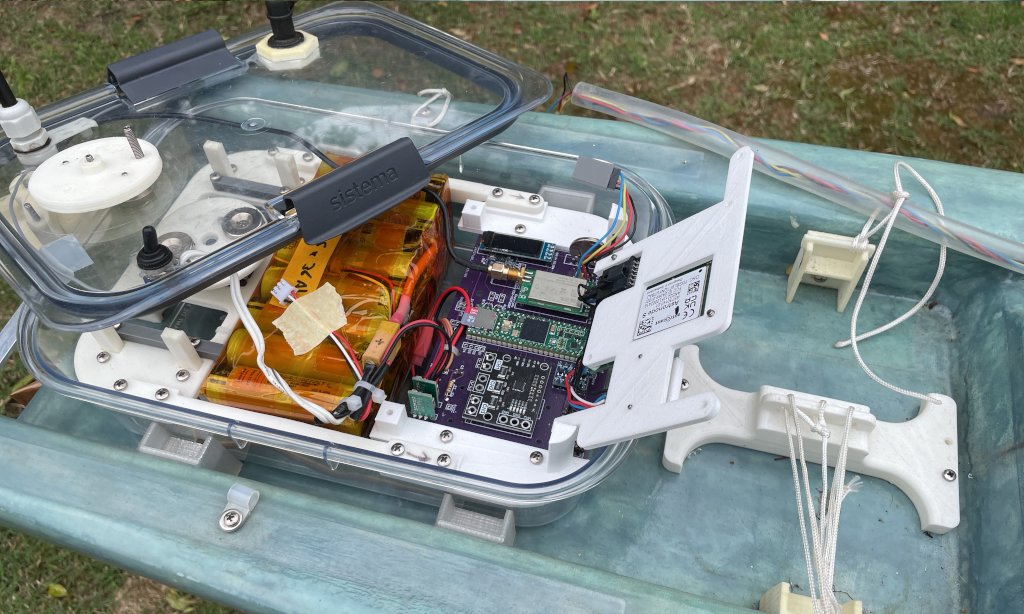
Imagine our joy when Ariel University’s Rony Ronen reached out to let us know that the Teensy 3.6 was being used as the main controller in their SATLLA-2B nanosatellite!

The 14×5×5cm sat transmits position and sensor data via amateur radio, which can be viewed on tinygs.com. More detail can be found on the iFixit assembly guide, which provides a comprehensive overview of the DIY satellite and its construction.