OLIA – Open-Source Digital Lock-In Amplifier

Andrew J. Harvie and John C. de Mello have created OLIA, an open-source digital lock-in amplifier. Digital lock-in is a method for isolating weak signals to facilitate measurement amongst background noise, which is processed away via digital signal processing (DSP).

The Open Lock-In Amplifier (OLIA) is a Teensy 4.0-based system that can outperform far more expensive commercial devices for around $35. OLIA offers dual-phase lock-in detection at multiple harmonic frequencies up to 50KHz, adjustable levels of input gain, and a comprehensive API for remote control. An optional breakout board allows optical detection down to 40 pW. Complete details about the project, as well as firmware, schematics, and BOM can be found in the original research paper.

Ottopot MIDI Controller

Gero Takke has created the Ottopot, a MIDI controller with “nothing but 8 dials.” But what dials they are! 14-bit MIDI CCs (changes) with a 1:1 mapping to physical movement provides an experience more akin to analog pots, but with continuous rotation.

Gero’s controller exceeds the typical resolution of MIDI control messages by sending two 7-bit messages to indicate a “course” and “fine” value, allowing 16384 values, instead of the typical 128. Mainstream DAWs like Ableton, Logic, and Bitwig support 14-bit CCs, although most hardware does not. Gero also recommends re-greasing the pots as part of the assembly process, for an even better experience. And optional LED rings make it even fancier!

Extensive detail, including detailed instructions, BOM, and everything else you need, can be found on Gero’s blog. A great demo can be found in the video below!

LED Lines Algorithm

The technology we experience as children can have a lasting impression. An algorithm that Mate Steinforth saw at a relative’s house had such an impression that three decades later it drove the creation of a Teensy-based realization in LED form.

Using the SmartLED Shield for Teensy 4 and a 64×64 LED matrix panel, Mate recreated the mesmerizing graphics from the childhood recollection, and shared the source on GitHub.

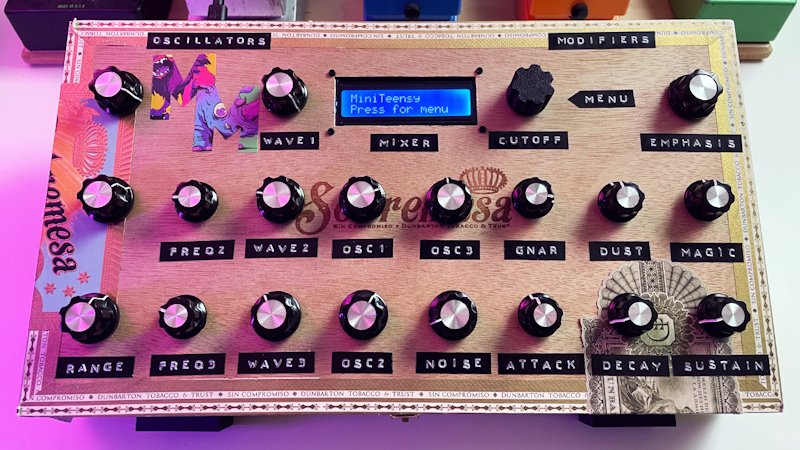
Polyphonic Digital/Analog Synth

Back in 2017, Paul designed a board for the Cirrus Logic CS42448 chip, which provides gobs of high-quality audio I/O, and shared it on OSH Park. PJRC forum member tubelab.com picked up a few of them, and created a 6-voice polyphonic hybrid digital/analog synth.

The eventual goal is to fit the project inside a guitar, but for now, it uses vacuum tubes for its Moog-style ladder filter, giving it that signature fat Moog sound.

The aim is to achieve six notes of polyphony with three oscillators per note, requiring 18 VCOs. Control is via standard 1V/oct or MIDI. Check out the video below for an overview, and stay abreast of updates via tubelab.com.

Dynamic Crankshaft Balancer

Ash Powers long dreamed of creating a crankshaft balancing rig, and through a combination of mechanical, electrical, electronic, and software expertise, his dream is now a reality.

The system is built around a Teensy 4.0, connected via gain amplifiers to a pair of load cells harvested from cheap digital scales. A magnetic rotary angle position sensor tracks rotations. The balancer averages ten samples from each load cell per degree of rotation, over 150 revolutions. This data is then sent via serial to a PC running custom Visual Basic software for analysis. Learn more and see it in action in the video below!

Pneumatic Robotic Skin

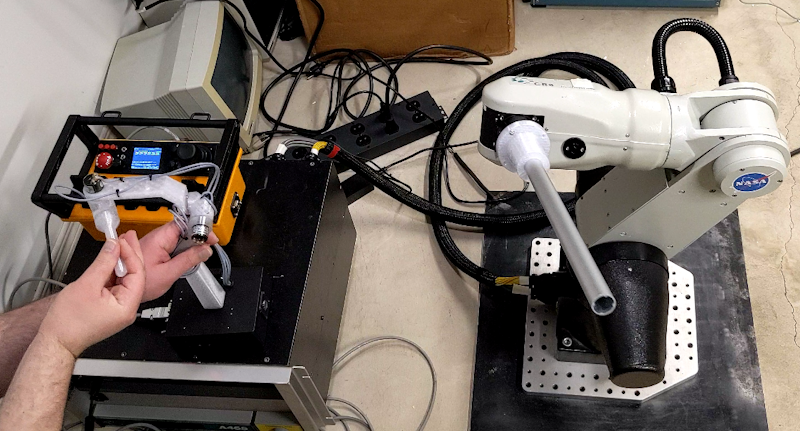
Researchers from Prof. Joohyung Kim’s KIMLAB (Kinetic Intelligent Machine LAB) at the University of Illinois Urbana-Champaign (UIUC) have developed a low-cost, easy-to-reproduce “pneumatic skin” that gives robots a sense of touch.

The solution consists of a 3d-printed TPU structure, attached to the robot arm with magnets. Eleven of these pneumatic pads, each coupled with a Honeywell ABPDANT005 pressure sensor, are connected to a PCB. The PCB is in turn connected to a USB hub, which interfaces with a Teensy 4.0. The video below demonstrates the system in action, including detecting a human arm caught in the robot’s elbow joint, which halts operation.

VoiceBot Language Helper

PJRC forum member VoiceBotX has created VoiceBot, a second language fluency-builder in the form of a Teensy 4.1-powered robot.

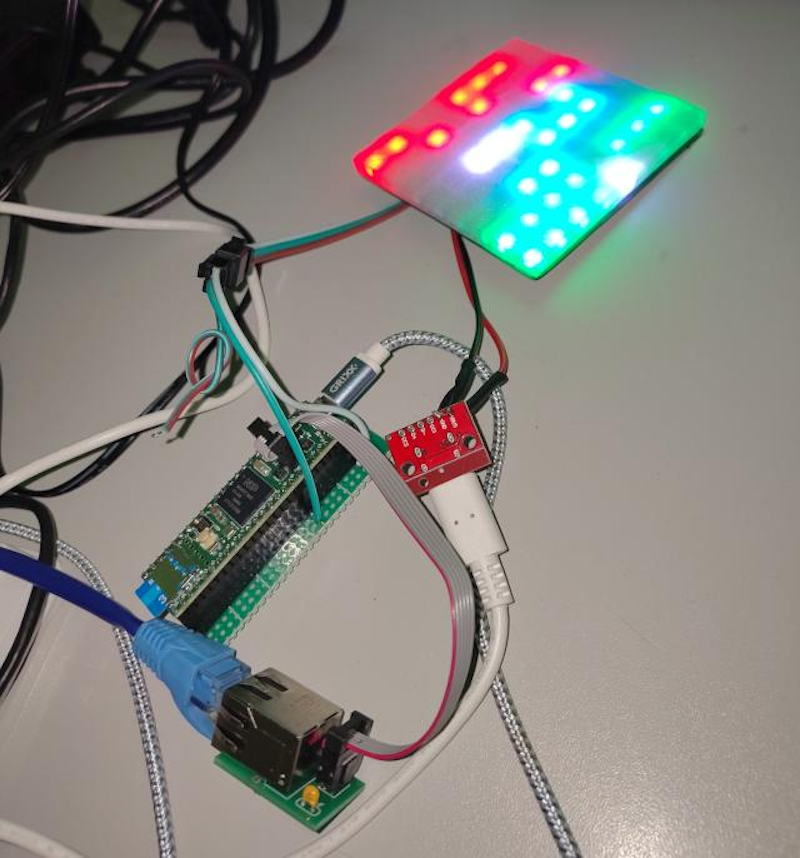
Contained in the 3d-printed shell is a Teensy 4.1 and Audio Adaptor Board, as well as haptic motors and drivers, some extra RAM, and an 8×8 RGB LED matrix. Using Teensy’s Ethernet, or USB serial via Chrome, the bot transmits a stream of visemes (speech sounds) to a web site, while also displaying them on the matrix, resulting in a lipsync-like representation of speech audio.

Science World Building Model Lighting

OH! is a sculpture created by PJRC forum member brendanmatkin and the Tangible team, which controls the lights on the Telus World of Science’s geodesic dome.

Based on the Teensy 3.5, OH! is a 1:60 scale model of the building, covered with 240 sensors, and connected to its full-scale counterpart by an LTE router.

When the sensors are interacted with, the corresponding light on the “real” dome is illuminated with various animations, such as sparkles, bands, and waves. PCA9617 I2C bus repeaters connect the 240 sensors, with a WIZ820 network module providing Ethernet. The Teensy also outputs an OSC signal on the LAN for the remote laptop to turn into music via Pure Data. Each sensor features an ATtiny841 microcontroller, an LED, and an IR sensor. Marvel as the Vancouver public animates the skyline with their very own hands in the video below.

Drone Synth with Soundfonts

After several years of experimentation, PJRC forum user JonathanZ has released a Teensy 4.1-based drone synth pedal using S. Christian Collins’ GeneralUser GS SoundFont bank.

Built around the Teensy Audio Adaptor Board and a 2.8″ ILI9341 touchscreen, the project leverages Kris Kasprzak’s Slider Controls for Touchscreen Displays library for its UI. manicken’s Sound Font Decoder for Teensy 4.1 also facilitated the project greatly. Source code for the ISO-Drone, as Jonathan calls it, can be found on GitHub, and an overview of its features and functionality can be seen in the video below.

DIY Handheld CNC Router

When most people think of CNC machines, they think of big, loud, messy, somewhat dangerous tools that take up a large amount of space. Traditional woodworking tools are often far smaller and more maneuverable, but lack the precision of Computer Numerical Control.

Cam Chaney’s open-source Compass handheld CNC router combines the fidelity of CNC with the flexibility of a hand tool that traverses the workpiece under human guidance. Four PMW3360DM optical gaming navigation (mouse) chips feed their data into a Teensy 4.1, which uses rigid body dynamics equations to determine the precise location and orientation of the attached Dremel rotary tool, continually autocorrecting the cut. This allows the use of traditional CAD/CAM software, with the added flexibility of being able to drag the device around walls, or other surfaces that would not usually find themselves on a CNC machine bed (plus, no need to worry about jigs/workholding!). More information is available on the Compass web site.