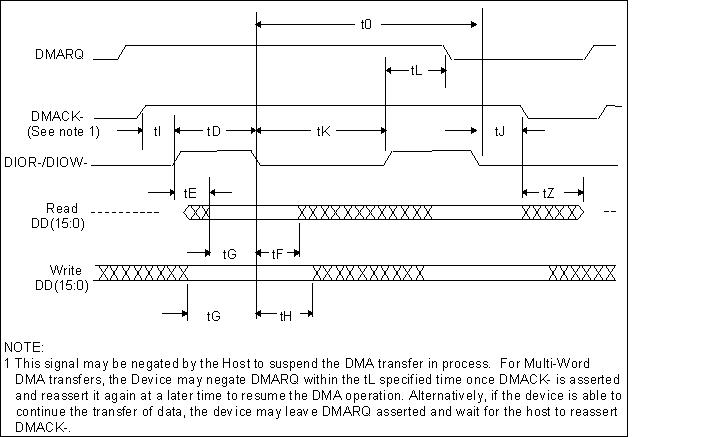
The host shall provide cable deskewing for all signals originating from the controller. The device shall provide cable deskewing for all signals originating at the host.
All timing values and diagrams are shown and measured at the connector of either device connected to the ATA interface. No values are given for measurement at the host interface.
Certain symbols are used in the timing diagrams. These symbols and their respective definitions are listed below.
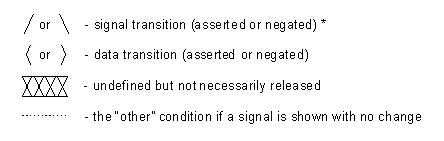
* All signals are shown with the asserted condition facing to the top of the page. The negated condition is shown towards the bottom of the page relative to the asserted condition.
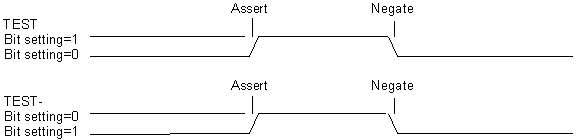
The interface uses a mixture of negative and positive signals for control and data. The terms asserted and negated are used for consistency and are independent of electrical characteristics.
In all timing diagrams, the lower line indicates negated, and the upper line indicates asserted e.g., the following illustrates the representation of a signal named TEST going from negated to asserted and back to negated, based on the polarity of the signal.
The minimum cycle time supported by the device in PIO Mode 3, 4 and Multiword DMA Mode 1, 2 respectively shall always be greater than or equal to the minimum cycle time defined by the associated Mode e.g. a drive supporting PIO Mode 4 timing shall not report a value less than 120 ns, the minimum cycle time defined for Mode 4 PIO Timings.
- PIO data transfers
- Multiword DMA data transfer
Figure 14 defines the relationships between the interface signals for PIO data transfers. Peripherals reporting support for PIO Transfer Mode 3 or 4 shall power up in a PIO Transfer Mode 0, 1 or 2.
For PIO modes 3 and above, the minimum value of t0 is specified by word 68 in the Identify Drive parameter list. The value in word 68 shall not be less than the value shown in Table 21.
IORDY shall be supported when PIO Mode 3 or 4 are the current mode of operation.
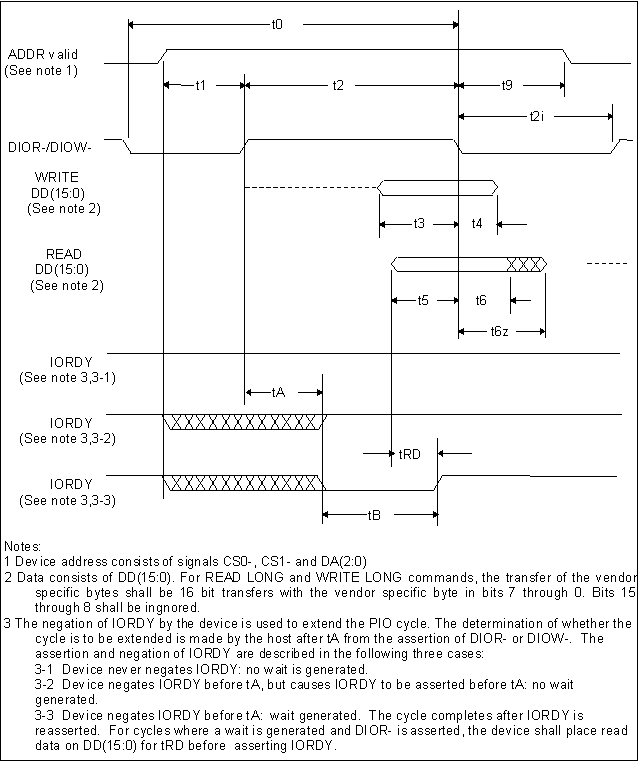 Figure 14 - PIO data transfer to/from device
|
PIO timing parameters |
Mode 0 ns |
Mode 1 ns |
Mode 2 ns |
Mode 3 ns |
Mode 4 ns |
Note |
||
|
t0 |
Cycle time |
(min) |
600 |
383 |
240 |
180 |
120 |
1 |
|
t1 |
Address valid to DIOR-/DIOW- setup |
(min) |
70 |
50 |
30 |
30 |
25 |
|
|
t2 |
DIOR-/DIOW- 16-bit |
(min) |
165 |
125 |
100 |
80 |
70 |
1 |
|
t2i |
DIOR-/DIOW- recovery time |
(min) |
- |
- |
- |
70 |
25 |
1 |
|
t3 |
DIOW- data setup |
(min) |
60 |
45 |
30 |
30 |
20 |
|
|
t4 |
DIOW- data hold |
(min) |
30 |
20 |
15 |
10 |
10 |
|
|
t5 |
DIOR- data setup |
(min) |
50 |
35 |
20 |
20 |
20 |
|
|
t6 |
DIOR- data hold |
(min) |
5 |
5 |
5 |
5 |
5 |
|
|
t6Z |
DIOR- data tristate |
(max) |
30 |
30 |
30 |
30 |
30 |
2 |
|
t9 |
DIOR-/DIOW- to address valid hold |
(min) |
20 |
15 |
10 |
10 |
10 |
|
|
tRd |
Read Data Valid to IORDY active (if IORDY initially low after tA) |
(min) |
0 |
0 |
0 |
0 |
0 |
|
|
tA |
IORDY Setup time |
35 |
35 |
35 |
35 |
35 |
3 |
|
|
tB |
IORDY Pulse Width |
(max) |
1250 |
1250 |
1250 |
1250 |
1250 |
|
|
Notes: 1 t0 is the minimum total cycle time, t2 is the minimum command active time, and t2i is the minimum command recovery time or command inactive time. The actual cycle time equals the sum of the actual command active time and the actual command inactive time. The three timing requirements of t0, t2, and t2i shall be met. The minimum total cycle time requirements is greater than the sum of t2 and t2i. This means a host implementation can lengthen either or both t2 or t2i to ensure that t0 is equal to or greater than the value reported in the devices identify drive data. A device implementation shall support any legal host implementation. 2 This parameter specifies the time from the negation edge of DIOR- to the time that the data bus is no longer driven by the device (tri-state). 3 The delay from the activation of DIOR- or DIOW- until the state of IORDY is first sampled. If IORDY is inactive then the host shall wait until IORDY is active before the PIO cycle can be completed. If the device is not driving IORDY negated at the tA after the activation of DIOR- or DIOW-, then t5 shall be met and tRD is not applicable. If the device is driving IORDY negated at the time tA after the activation of DIOR- or DIOW-, then tRD shall be met and t5 is not applicable. |
||||||||